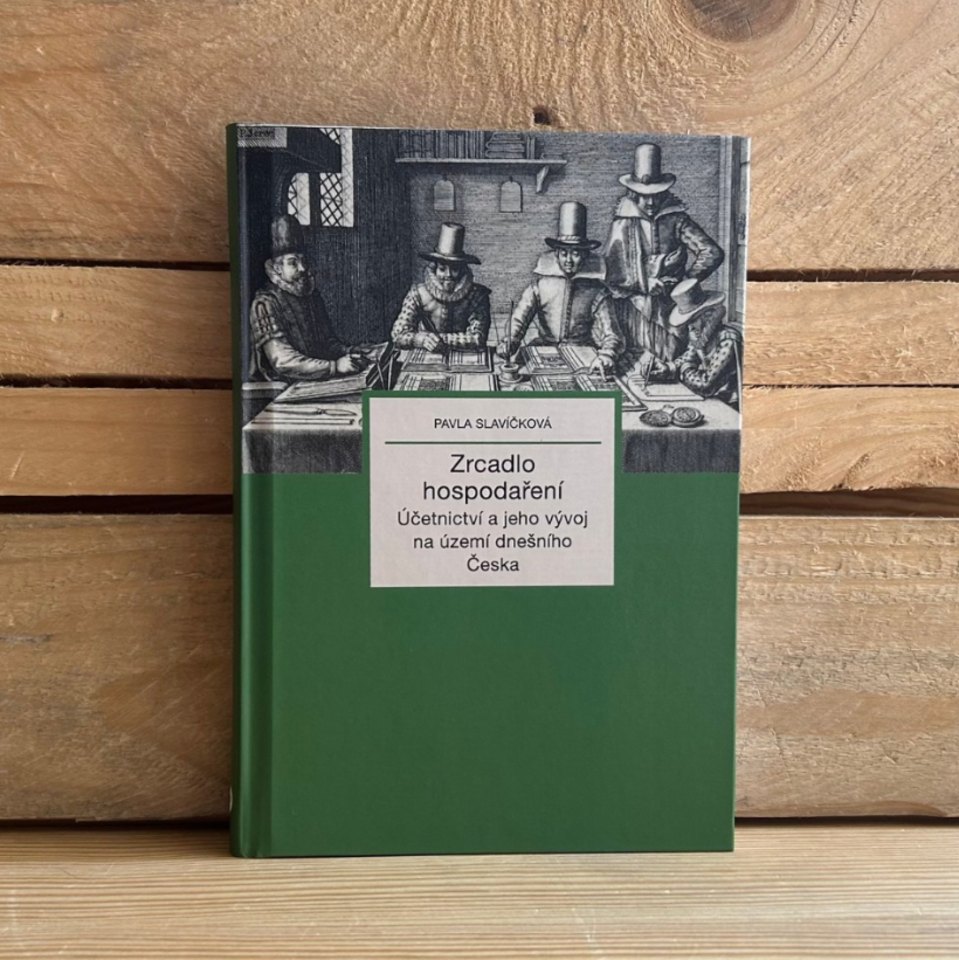
How did people manage resources in our region from prehistory to the early modern period? What can seemingly dry accounting records tell us about who we are, and why is it still important to understand them in the 21st century?
Assoc. Prof. Pavla Slavíčková has published a new book titled Mirror of Stewardship. Bookkeeping and Its Development in the Territory of Present Czechia, which shows that accounting is not merely a set of technical procedures, but above all a reflection of people, their priorities, and the times in which they lived. The book explores not only the development of accounting systems, but also what accounting records themselves can reveal about human behaviour and society.
“I wanted to show that accounting systems are not just technical tools, but a reflection of the era in which they were used,” explains Slavíčková. In her new publication, released by the Lidové noviny publishing house, she goes beyond a simple description of record-keeping practices. At the core of her work is what she calls accounting thinking — the ways in which people in different periods captured, structured, and interpreted their economic activities through contemporary manuals, textbooks, and legal regulations. In this perspective, accounting becomes a fascinating testimony to how people in the past sought order, control, and understanding of the world around them.
Interestingly, the book is not the result of solitary archival research alone. It grew out of ongoing discussions with students during lectures. “We don’t just talk about how accounting was done, but mainly why it was done that way,” Slavíčková adds. This search for meaning and logic in historical economic practices became a key impulse for the book itself. In this sense, students indirectly became part of the process, contributing to a perspective that views accounting as a mirror of society.
Beyond its clear academic contribution, the book also carries a personal dimension that offers a glimpse into the realities of academic work. The final version of the manuscript was completed during a period when Slavíčková had just welcomed her newborn son. The specific conditions of early motherhood brought an unexpected sense of discipline and focus to the writing process. “Writing naturally intertwined with caring for a little baby. I wrote in short intervals between naps, in moments when it was necessary to concentrate quickly and fully,” she recalls. This pressure ultimately benefited the text — there was no space for unnecessary words, and each sentence had to be precise and meaningful. “Because of that, the book is not only an academic publication for me, but also a personal trace of a very intense period,” she adds.
At the same time, the book shows that understanding how people managed resources in the past can help us better grasp the economic realities of today. It offers valuable insights for anyone interested in economic history, accounting, or the cultural foundations of economic life.
We would like to thank Assoc. Prof. Slavíčková for her work, energy, and enthusiasm, through which she brings accounting into broader contexts not only for students but also for the wider academic community.
If the book has caught your interest and you would like to support her work, Mirror of Stewardship (published in Czech) can be purchased here:
https://www.kosmas.cz/knihy/565434/zrcadlo-hospodareni/